
Second-Use
Recycling
Technology
PROUDLY FEATURED IN:









What does RUBIN stand for?
In the third funding round of the “Regional Entrepreneurial Alliances for Innovation” (RUBIN) program, the German Federal Ministry of Education and Research (BMBF) is funding strategic collaborations between companies and universities and research institutions. The aim is to develop innovations with high potential for practical application.
News
23 April – RegioREC alliance meeting
Agenda
10.00 am to 12.30 pm
Project workshop
- Project status
- Discussion & Evaluation
12.30 pm to 1.00 pm
Lunch break
1.00 pm to 3.00 pm
Strategy workshop
- Current Situation & Market/Technology Trends
- Summary of the strategy in the RUBIN concept
- Key topics
- Panel discussion
- Conclusions
3.30 pm to 4.30 pm
General Meeting
- Welcome / Agenda
- Project status – Overview of all partners
- Financial Planning 2026/2027
- Public Relations Concept
- Discussion / Resolution on the cash balance
- Election of the Alliance Leadership
- Future
Project & Objective
What does RUBIN RegioRec stand for?
Recycling and second-life use of lithium-ion batteries
The RUBIN RegioREC consortium is addressing one of the key issues for the future of the energy transition: the safe, efficient and cost-effective management of lithium-ion batteries throughout their entire life cycle.
Lithium-ion batteries have become indispensable in industry, commerce and private use. Their high performance is driving their ever-increasing adoption – particularly in electric mobility and stationary energy storage. At the same time, the raw materials required for their manufacture are in limited supply and unevenly distributed globally. This creates a clear need for action: batteries must be used for longer, systematically reused (second-use) and, at the end of their life cycle, recycled to a high standard.
Why new technologies are necessary
This is precisely where RegioREC comes in. A key obstacle to the expansion of second-use and recycling infrastructure has so far been the lack of suitable pre-processing technologies. These include, in particular, solutions for the safe collection, condition assessment, controlled unloading, sorting, (pre-)dismantling and transport of lithium-ion batteries.
These processes form the basis for decentralised supply hubs, which enable both cost-effective material recovery at centralised recycling facilities and cascaded reuse in second-use applications. At the same time, they pose significant technical challenges, as lithium-ion batteries contain potentially toxic, flammable and safety-critical materials.
RegioREC brings together expertise from research, development and industry to bridge precisely these technological gaps and create safe, scalable solutions for a sustainable battery economy.
Take-Away:
RegioREC develops key technologies for the safe assessment, handling and reuse of lithium-ion batteries, thereby enabling second-use applications and high-quality recycling.
What are the objectives of RUBIN RegioREC?
The RUBIN consortium RegioREC aims to develop a technically mature and regionally scalable circular economy system for lithium-ion batteries. The starting point is the realisation that, despite their different designs, many types of battery are based on the same core components – yet these have not, to date, been systematically consolidated and efficiently recycled.
To this end, RegioREC is developing a technological innovation platform that enables the safe handling of lithium-ion batteries throughout all process stages. This includes, amongst other things, solutions for handling, recycling and condition assessment, as well as sensor-based monitoring of safety-critical processes. The aim is to achieve a leading international position in this field of technology.
On this basis, handling and process environments compliant with regulatory requirements are being created, enabling both industrial battery recycling and the development and use of second-use battery storage systems of various sizes and applications. In addition, advanced material processing technologies with integrated recovery of valuable materials are to be developed.
In the long term, RegioREC aims to create a modular, secure and globally adaptable system that can be used for regional catchment areas. This will enable the establishment of closed-loop, regionally adaptable value chains – from the receipt of the battery to the new product – which make a measurable contribution to reducing CO₂ emissions.
Take-Away:
RegioREC aims to achieve the cost-effective recycling of lithium-ion batteries in standardised, regionally decentralised recycling facilities. To this end, the consortium is developing safe, modular and easily adaptable technological process environments.
Partners & Network
A strong network for the future of batteries
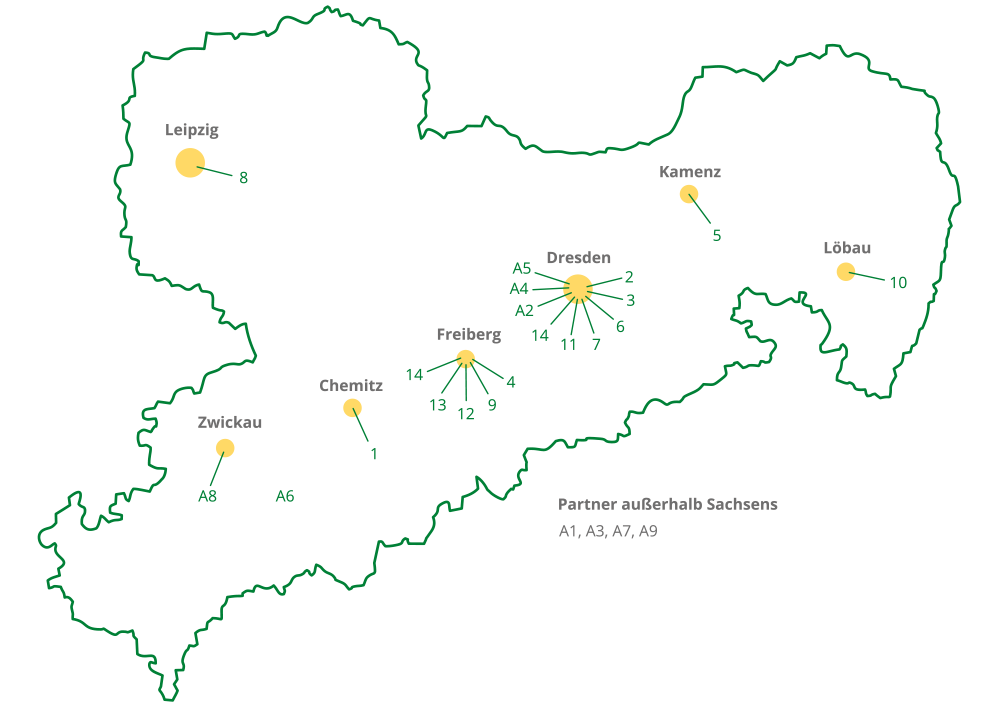
The RegioREC Alliance is firmly established in Saxony and benefits from a strong regional network of companies, research institutions and initiatives involved in battery recycling. The Freiberg–Dresden corridor is a leading centre of scientific excellence, represented by the TU Bergakademie Freiberg, the TU Dresden, Fraunhofer Institutes such as IKTS and IWU, and the Helmholtz Centre Dresden-Rossendorf.
RegioREC works closely with existing regional initiatives, in particular with the ‘Bildungsverbund Batterie Mitteldeutschland’ (Central German Battery Education Network), which strengthens the supply of skilled workers across the battery value chain. Activities relating to knowledge transfer in the field of the circular economy are also key to ensuring public acceptance and understanding of the alliance’s future sites and technologies.
Industry partners
- 1 | Becker Umweltdienste GmbH
- 2 | DAS Environmental Expert GmbH
- 3 | DKS GmbH Engineering und Vertrieb
- 4 | ERZLABOR Advanced Solutions GmbH
- 5 | Liofit GmbH
- 6 | Mercedes-Benz Energy GmbH
- 7 | meta Messtechnische Systeme GmbH
- 8 | tecVenture GmbH
- 9 | TRICERA energy GmbH
- 10 | ULT AG Umwelt-Lufttechnik
- 11 | Viimagic GmbH
Research partners
- 14 | Fraunhofer Society for the Advancement of Applied Research e.V.
Associate partners
- A1 | GRS Batterien Service GmbH
- A2 | Stadtreinigung Dresden GmbH
- A3 | Infotech Gesellschaft für Informations- und Datentechnik mbH
- A4 | GICON - Großmann Ingenieur Consult GmbH
- A5 | NOVUM Engineering GmbH
- A6 | Nickelhütte Aue GmbH
- A7 | BASF Battery Materials and Recycling Schwarzheide GmbH
- A8 | Erlos Produktion und Montagen GmbH
- A9 | Chemiepark Bitterfeld-Wolfen GmbH
JOINT PROJECTS
Key research areas and collaborative projects
RegioREC brings together research, technological development and industrial practice to create a regionally adaptable circular system for lithium-ion batteries. The focus is on safe process environments, modular handling solutions, second-use applications and the material recovery of valuable resources. The project structure is divided into work packages that cover research, development, piloting and knowledge transfer across the entire battery value chain.
Take-Away:
RegioREC provides technological solutions covering the entire battery life cycle.
The 4 collaborative projects (CP)
-
CP 1 – 5 partners
Reliable battery monitoring & condition assessment -
CP 2 – 5 partners
Handling, unloading & (pre-)dismantling -
CP 3 – 6 partners
Second-use applications -
CP 4 – 7 partners
Material recycling & resource recovery
Project structure and key areas
Collaborative project 1
Logistics interfaces, data management & preparatory processes
Key topics
Logistics services
(Collection and transport systems)
Cell processing / Separation of black masses
Sensory components / analytical methods
(for process monitoring and automation)
Infrastructure and data management tools
Collaborative project 2
Battery condition diagnostics and second-life systems
Key topics
Categorisation of input material streams / second-use applications
Sensory components / analytical methods
(for process monitoring and automation)
Infrastructure and data management tools
Collaborative project 3
Process media management / treatment
of gaseous and particulate components
Key topics
Treatment / Shutdown of secondary circuits for process media
Separation of valuable components / Generation of marketable product streams
Cell processing / Separation of black masses
Sensory components / analytical methods
(for process monitoring and automation)
Infrastructure and data management tools
Collaborative project 4
Process media management / handling
of liquids and solids
Key topics
Treatment / Shutdown of secondary circuits for process media
Separation of valuable components / Generation of marketable product streams
Cell processing / Separation of black masses
Sensory components / analytical methods
(for process monitoring and automation)
Infrastructure and data management tools
Safety & Standardisation

Contribution to the circular economy and CO₂ impact
Technology and Innovation Approach
RegioREC develops modular, sensor-monitored process environments for the safe handling of lithium-ion batteries. These technologies form the basis for second-use applications as well as for high-quality material recycling.
Take-Away:
RegioREC bridges the technological gaps between the use, reuse and recycling of batteries.
All partners in the alliance place great importance, within
their collaborative projects, on:
Modular process chains
Sensor-based monitoring
Safe handling and dismantling environments
Preparing for second-use and recycling
Safety & Standardisation
A key focus of RegioREC is the development of safe, standardised and regulatory-compliant processes for the handling of lithium-ion batteries throughout all stages of their life cycle.
Take-Away:
Safety and standardisation are fundamental prerequisites for scalable battery cycles.
All partners in the alliance pay particular attention to the following within their collaborative projects:
Handling hazardous substances
Preventing the risk of explosions
Admissibility
Standardised processes
Regional exemplary nature & transferability
RegioREC sees itself as a regional model with international applicability. The technologies and process chains developed are modular in design and can be adapted to different regions and use cases.
Take-Away:
Thinking regionally – planning and implementing with a global perspective.
All partners in the alliance place great importance on the following within their collaborative projects:
Regional catchment areas
Decentralised ‘hubs’
Global adaptability
Contribution to the circular economy and CO₂ impact
Through second-use applications and high-quality recycling, RegioREC makes a measurable contribution to conserving resources and improving the carbon footprint along the battery value chain.
Take-Away:
Longer use, better recycling, lower resource consumption.

CONTACT
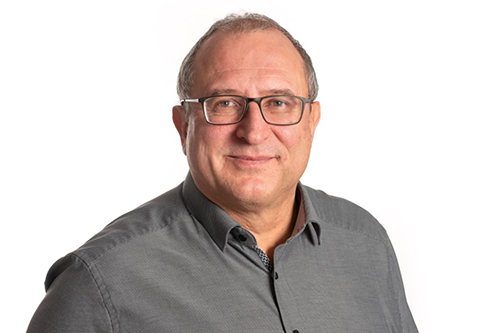
Speaker
Liofit GmbH
An der Nordbahn 3
01917 Kamenz
- © 2026 RegioRec - WordPress Theme von Kadence WP